
A couple of years ago, Narendra Modi claimed that he was not born through the ordinary biological process but had been sent to Earth by divine power.A couple of years ago, Narendra Modi claimed that he was not born through the ordinary biological process but had been sent to Earth by divine power.
Modi said: “When my mother was alive, I used to believe that I was born biologically. After she passed away, upon reflecting on all my experiences, I was convinced that God had sent me. This energy could not be from my biological body but was bestowed upon me by God… whenever I do anything, I believe God is guiding me.” — Business Today, May 23, 2024.
His ardent followers, often derisively referred to as the “Modi Bhagats”, readily embraced this narrative, elevating him from a politician and prime minister of India to a divinely chosen figure destined to rescue India from its present predicament and, by extension, to save humanity.
A couple of years ago, Narendra Modi claimed that he was not born through the ordinary biological process but had been sent to Earth by divine power.
The broader ecosystem of Modi supporters, the Bharatiya Janata Party (BJP), and its political and religious affiliates has further promoted his image as Vishwa Guru, a “world teacher” or spiritual guide capable of showing not merely India but the entire world the way forward.
This carefully cultivated image of Modi as a spiritually endowed leader has been reinforced by his public persona: his distinctive attire and meticulous grooming, his frequent visits to Hindu temples, his participation in religious ceremonies, including the inauguration of the Ram Temple, built at the site where the Babri Masjid stood, and his highly publicized meditation sessions at sacred Hindu sites and caves.
Together, these carefully choreographed symbols and appearances have helped transform Modi’s political image into something larger: that of a leader portrayed by his admirers not simply as an elected prime minister, but as a divinely guided figure with a mission extending far beyond India’s borders.
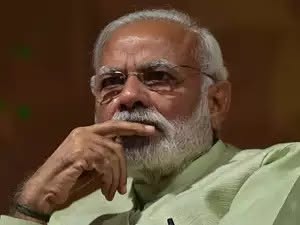
Since Narendra Modi assumed office as India’s prime minister in 2014, he has worn several political masks, including a veneer of divinity, each designed to dramatize his promises, from “Achchey Din” (good days), jobs, and prosperity to his pledge to propel India forward by restoring it to the mythical status of Sone Ki Chidya—the “Golden Bird” of India’s imagined glorious past.
Over the years, this carefully cultivated persona has elevated Modi beyond the status of an ordinary politician. He has become a cult figure, to the point where some of his followers treat him with a reverence approaching worship.
Behind this carefully constructed image, however, critics argue that Modi’s government has undertaken some of the most consequential and disturbing measures in modern Indian politics, profoundly affecting the country’s democratic institutions and its secular character.
The judiciary, Election Commission, media, and statistical institutions are among the essential pillars that keep a democracy authoritative, functional, dynamic, and accountable.
When these institutions are weakened, corrupted, compromised, politicized, or systematically abused, democracy itself is diminished, and can eventually become little more than a façade.
Under Modi, democratic institutions have been subjected to both overt and subtle forms of political manipulation.
Religious polarization, fear, intimidation, alleged extrajudicial violence, police action against political opponents, pressure on the media, bureaucratic interference, and exaggerated or deceptive claims of accomplishment have become recurring features of the political landscape.
Political appointments have also increasingly been viewed through the lens of loyalty and ideological alignment rather than solely through competence, suitability, and professional or academic credentials.
Critics have raised questions about appointments and selections involving Supreme Court judges, state governors, the governor of the Reserve Bank of India, university vice-chancellors, Election Commission officials, senior military leadership, and the film-censorship apparatus.
The Constitution, meanwhile, risks being reduced from the supreme framework of governance to something largely ceremonial.
In an environment where political loyalty can appear to take precedence over constitutional principles, the ultimate test of allegiance becomes not what the Constitution requires, but what the prime minister and his political establishment expect.
The media landscape has suffered a similar transformation.
With due respect to the courageous journalists and independent outlets that continue to practice vigorous journalism, much of the mainstream media has been accused of becoming an echo chamber for the government, reporting selectively, amplifying favourable narratives, minimizing inconvenient facts, or ignoring stories altogether.
In its most troubling form, propaganda is manufactured within political publicity networks and distributed through sympathetic news outlets and social-media platforms.
An army of loyal online supporters, appropriately referred to as “Bhagats”, then helps disseminate these narratives across India and among the Indian diaspora worldwide, turning political propaganda into a seemingly organic public consensus.
The consequences for free expression have been particularly disturbing.
Crackdowns on dissent, intimidation of journalists and activists, and attacks or threats against writers, lawyers, academics, and political critics have contributed to a climate in which speaking against those in power can carry an increasingly heavy price.
The treatment of religious minorities has raised even more profound concerns.
Cases of mob violence and lynching have occurred, while individuals accused of attacks against minorities have, in some instances, received political or public support rather than unequivocal condemnation.
There have also been occasions when rallies were organized in support of individuals accused of rape or other serious crimes, rather than in solidarity with their victims.
Taken together, these developments point to what can be described as a deliberate process of institutional chiselling: the gradual reshaping of India’s democratic and secular architecture to fit the narrower ideological contours of the Hindutva project.
And at the center of this grand chiselling stands Modi himself.
Through symbolism, spectacle, religious imagery, political mythology, and the adulation of his followers, he has been transformed from an elected politician into something approaching a sacred political figure, portrayed by some admirers as an incarnation of Vishnu, one of the principal deities of Hindu mythology.
Largely untouched and unquestioned, especially within his own party, the Bharatiya Janata Party, and among millions of his ardent supporters in India and abroad, Modi has thus emerged, in the eyes of his most devoted followers, not merely as a prime minister, but as a figure invested with an almost divine authority.
But then came July 2026.
An obscure figure, a scholar and PhD student from Boston University named Abhijeet Dipke, appeared seemingly out of nowhere and began dismantling the carefully constructed image of Narendra Modi.
The carefully scripted divinity narrative suddenly faltered.
In its place, something entirely unexpected emerged: a political “Jantar Mantar” of almost divine proportions.
Dipke, joined by a small group of followers, issued a bold and impassioned call to India’s youth and students to march to Delhi’s designated protest site, Jantar Mantar.
Adopting the unlikely symbol of the Cockroach, they descended on the protest grounds in the hundreds of thousands, demanding sweeping reforms to the country’s education system and the resignation of the education minister.
Within days, the movement inflicted a stunning political blow on Modi.
A public persona painstakingly constructed over years, with enormous political, financial, and institutional resources behind it, appeared to unravel in little more than two weeks.
The contrast could hardly have been more striking.
An image that had taken decades to manufacture was suddenly being challenged by young protesters who had chosen, of all things, the cockroach as their emblem.
Speaking in Delhi on August 3, the acclaimed author and activist Arundhati Roy captured the extraordinary reversal:
“The image of 24 years… made by spending crores of rupees, where some call him the incarnation of Vishnu, and in two weeks, cockroaches have destroyed that whole 24 years.”
The symbolism was devastating.
Modi had spent years presenting himself as larger than politics, as a leader blessed by destiny, history, and divine power.
Yet within a matter of weeks, an unexpected student movement appeared to puncture that carefully cultivated aura and expose the vulnerability beneath the spectacle.
-Promod Puri
promodpuri.com


