
Things get created; things get destroyed in the universe.
In other words, what appears to be creation is also the first step toward destruction, leading eventually to another creation.
The cycle continues endlessly.
We human beings reside in this vast void along with plants, animals, mountains, rivers, rocks, stars, and countless living and non-living entities.
Side by side with all existence dwells another silent but fundamental element, the space, separating and distinguishing everything in the universe.
But that distinction is temporary.
All of us float in space in one form or another, like clouds drifting across the sky.
Under the blue dome, a bear-shaped cloud merges into a dragon, then reshapes into the outline of a country, a pond, a pig, or a tree.
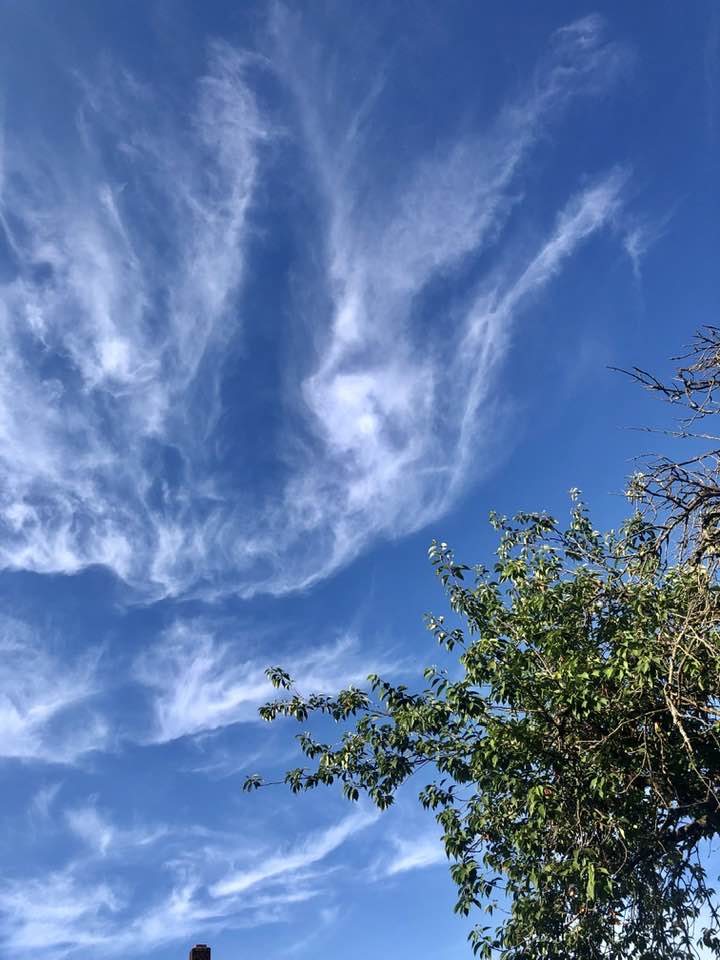
It floats for a while, then dissolves into another wandering cloud or breaks apart into a new formation.
What looked permanent was merely a passing arrangement.
The phenomenon continues throughout nature.
Humans are also part of this endless choreography of creation and dissolution, contributing to forms that arise and disappear, only to re-emerge differently, consciously or unconsciously, or merge back into dust.
As Pablo Picasso observed, “Every act of creation is first an act of destruction.”
Nature continuously edits itself.
We notice things only when they acquire a fixed shape, size, duration, or identity.
The scattered vapours in the sky seem meaningless until they gather into clouds. Yet even a cloud has no permanence.
It transforms into rain, mist, snow, or disappears into invisible humidity. One appearance ends so another may begin.
The Buddha captured this eternal truth: “Nothing is forever except change.”
Clouds make the mystery easier to understand because their transformations are visible before our eyes. But most things around us are far more complex.
The human body, for example, is composed of water, minerals, proteins, acids, bones, and countless chemical compounds, temporarily assembled into a conscious form we call a person.
When the conscious body dies, its elements do not.
They separate, merge, recycle, and reorganize into other forms , like clouds reshaping in the sky.
The same principle applies to a tree, a bird, a toad, or even a distant star.
Carl Sagan reminded humanity of this cosmic relationship when he said, “We are made of star stuff.”
Everything remains within the great universal pot, dissolving from one form and evolving into another.
Nothing truly vanishes; it only changes appearance.
The Bhagavad Gita echoes the same understanding:
“For the soul there is neither birth nor death at any time.”
And the Greek philosopher Heraclitus observed:
“No man ever steps in the same river twice, for it is not the same river and he is not the same man.”
Existence itself is movement.
Living and dying are not opposites; they are partners in transformation.
Every formation , conscious or unconscious, is connected to another formation.
Everything changes, merges, separates, and reappears, just like clouds in the sky.
Perhaps permanence is only an illusion created by the temporary stability of form.
The universe, meanwhile, continues its silent dance of becoming and unbecoming.
–Promod Puri
progressivehindudialogue.com
promodpuri.com


