
by Promod Puri
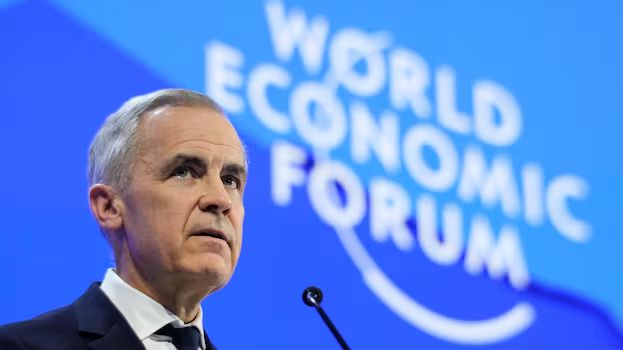
Canadian Prime Minister Mark Carney’s speech at the Davos Economic Summit earlier this week was widely hailed as refreshingly candid—an unvarnished take on the shifting political and economic realities ushered in by Trump 2.0.
It became the standout moment of Davos. Carney didn’t just hold the room; he effectively upstaged Donald Trump, whose own presence was already diminished by his tactical retreat from an earlier belligerent stance on the takeover of Greenland. In contrast, Carney spoke with clarity, confidence, and quiet defiance.
Without naming names, Carney took a pointed swipe at Trump’s bullying posture toward virtually every nation on the planet, Canada included. His words were carefully chosen but unmistakably sharp:
“More recently, great powers have begun using economic integration as weapons. Tariffs as leverage. Financial infrastructure as coercion. Supply chains as vulnerabilities to be exploited.”
This raises an obvious question: besides the United States, which other countries was Carney referring to as “great powers”?
His reference to “middle powers” was straightforward—countries like Canada and Australia clearly fall into that category. But the repeated use of “great powers” was intriguing, even strategic.
The phrase surfaced again when Carney warned that if great powers abandon even the pretense of rules and values in the unchecked pursuit of power, the gains of “transactionalism” would eventually collapse. Hegemons, he argued, cannot endlessly monetize their relationships.
Was this plural phrasing—great powers instead of the great power—a diplomatic courtesy? A rhetorical shield meant to avoid provoking Trump directly?
If so, it failed.
Trump wasted no time responding. In his own address to the World Economic Forum the following day, he singled out Carney by name—a rare break from Carney’s studied restraint.
“Canada lives because of the United States,” Trump declared. “Remember that, Mark, next time you make your statements.”
With that remark, Trump removed all ambiguity. In his mind, the “great powers” Carney referred to were none other than the United States itself.
So why did Carney avoid explicitly naming the U.S. and its president as the source of the current political and economic turmoil?
Because Carney understands something Trump does not—or chooses to ignore. Naming is less important than diagnosing the disease. And Carney delivered his most important insight toward the end of his address:
“There is a strong tendency for countries to go along to get along. To accommodate. To avoid trouble. To hope that compliance will buy safety. It won’t.”
In one sentence, Carney dismantled the illusion that submission guarantees security. History, after all, has never been kind to those who confuse appeasement with survival.

 Promod Puri.com