
By Promod Puri
Paldi, named after a small town in Hoshiarpur District of Punjab, is located about seven miles southwest of Duncan, off the road to Lake Cowichan on Vancouver Island in British Columbia, Canada.
Mayo Singh, his brother Ganea Singh, and their cousin Doman Singh established the town of Paldi in 1916. They came to Canada in 1906.
Mayo Singh, the most well-known founder of Paldi, was born in 1888 in his native town of Paldi, Hoshiarpur. His birth name was Mayan Singh. He came to Canada at the age of 18.
Paldi was initially named Mayo after Mayo Singh. However, it changed its name in 1936 due to confusion at the post office in Mayo, Yukon. Then, the town was renamed Paldi, from where Doman, Ganea, and Mayo had migrated.
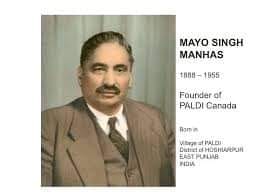
The town has a glorious past. It was bursting with over 1500 inhabitants, mainly from Punjab, working in the sawmills and as loggers.
By 1919, the community established a Gurdwara and then a school.
In addition to the “Hindoo” population, as they were all called at that time, Paldi was a multicultural community of Japanese, Chinese, and immigrants from various other nationalities.
The Japanese community of Paldi built a wooden hall next to the Gurdwara in 1923. The hall served as a Buddhist temple and a meeting place.
Paldi’s reminiscences are reflected in its Indian-sounding street names, like Ranjeet Street, Bishan Street, Jindo Street, and Kapoor Road, which cover the entire little town.
The Gurdwara occupied the centre stage, and the atmosphere in Paldi during its heydays was typical of Punjab village. The Punjabi community brought along its social and cultural traditions. Sports events and festivals were part of life in Paldi. The big annual affair was the “Jor Mella,” a festival of events like soccer, volleyball, and kabaddi.
India’s first Prime Minister, Jawaharlal Nehru, visited Paldi on a trip to British Columbia in November 1949.
Over the years, most original families left Paldi for better job prospects in Cowichan Valley and Nanaimo. By 1975, the Japanese, European and Chinese families had all left the village. The last few Indian families remained in Paldi till the late ’80s.
One of them was Joan Mayo, daughter-in-law of Mayo Singh, who wrote Paldi Remembered in 1997. The book is a collection of stories and pictures that tribute the once-bustling lumber mill town.
I met Joan and her husband, Ranjindi Singh Mayo, in Paldi in the early ’90s. The meeting revealed many interesting stories about life in Paldi.
Paldi Gurdwara was designated a Historic Site by the Cowichan Valley Regional District in 2014.
For the people of South Asian origin in Canada, Paldi is a historical place.
In its dirt lie the memorable annals of the time, which saw the glory amid the community’s hardships. Paldi is a significant chapter of our struggles, accomplishments, and pride in Canada’s recent history.

 Promod Puri.com